

Single-Layer vs. Multilayer Cosmetic Tubes: What Should Your Brand Choose?
November 19, 2026 | By Admin
Two cosmetic tubes can look identical on the shelf—and perform very differently once filled.
For packaging buyers, the real question is not “How many layers can we get?” It is “What protection does our formula need, and what are we paying for?”
Here is how to compare your options before placing an order.
What Is Inside the Tube Wall?
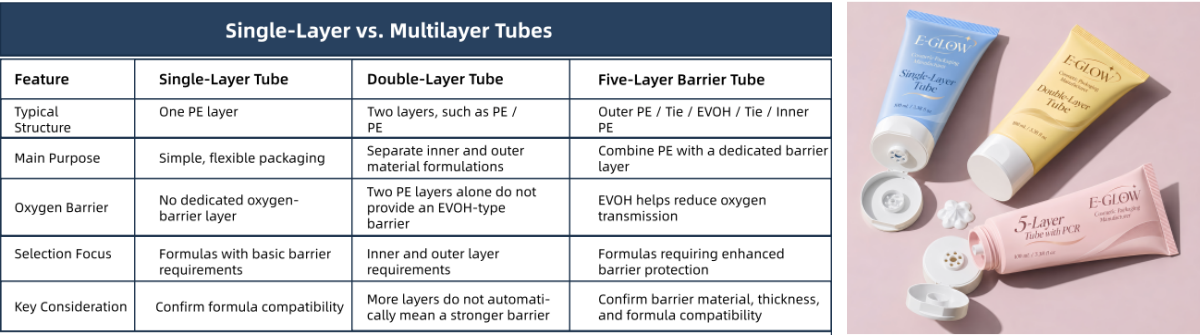
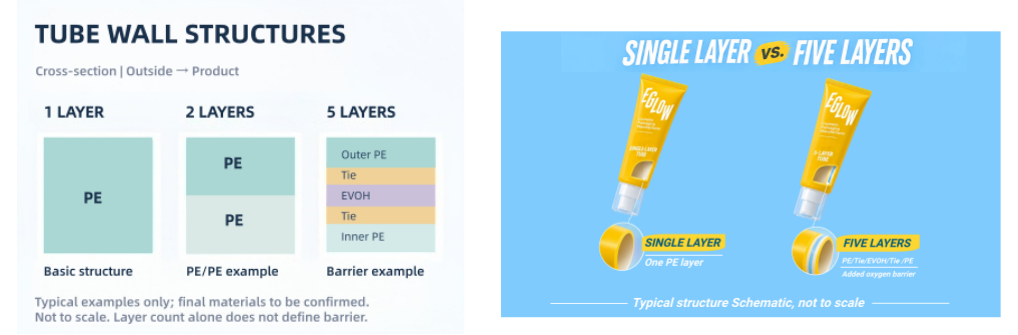
A single-layer tube typically uses one polyethylene (PE) layer. It offers a straightforward, flexible packaging format for formulas with basic barrier requirements.
A multilayer tube combines layers with different functions. A common five-layer barrier structure is:
Outer PE → Adhesive → EVOH Barrier → Adhesive → Inner PE
The outer PE provides a surface for decoration, the inner PE contacts the formula, and the EVOH layer helps reduce oxygen transmission and aroma loss.
However, more layers do not automatically mean better protection. A double-layer PE/PE tube has no dedicated EVOH barrier, and a five-layer tube is not necessarily thicker than a single-layer alternative.
Three Questions to Ask Before Ordering
1. What Could Go Wrong With Your Formula?
Start with the product, not the packaging catalog.
Is oxygen exposure a concern? Could fragrance loss affect the customer experience? What shelf life and storage conditions must the finished product withstand?
A stable daily-care formula may perform well in a single-layer tube. A formula with greater oxygen sensitivity or aroma-retention requirements may justify a dedicated barrier structure.
Product names alone are not enough: two hand creams can have very different packaging requirements.

2. Are You Comparing Equivalent Quotations?
A lower tube price is only meaningful when the specifications match.
Ask suppliers to confirm:
- Material structure: Which materials are used in each layer?
- Dimensions and wall thickness: Are the quotations based on the same specifications?
- Complete components: Are the pump, cap, decoration, and sealing requirements included?
- Validation: What testing supports the proposed packaging for your formula?
This helps prevent a basic PE tube and a barrier tube from being treated as interchangeable options.
3. Has the Complete Pack Been Tested?
A good tube wall cannot compensate for a poor seal or an unsuitable dispensing system.
Test filled samples for formula compatibility, stability, leakage, and transport performance. For airless pump tubes, also check dispensing consistency and product evacuation.
The barrier wall and airless pump do different jobs: one limits permeation through the material; the other manages dispensing and air intake during use.
4.Can Multilayer Tubes Incorporate PCR Materials?
Yes. PCR (post-consumer recycled plastic) can be incorporated into selected layers of a multilayer tube, while other layers provide formula contact or barrier functions. The suitable placement and percentage depend on the recycled material’s quality, the tube design, and formula compatibility.
For buyers, ask which layer contains PCR, how its percentage is calculated, and what testing supports the finished tube’s performance. A higher PCR percentage alone does not guarantee a better packaging solution.
Buy the Protection You Need
Over-specifying can increase packaging costs without delivering meaningful value. Under-specifying can create product-quality problems that cost far more than the initial saving.
Choose the simplest structure that meets your formula, shelf-life, and customer-experience requirements—and confirm it through testing before committing to production.
Start With Your Formula. Build the Right Packaging.
You do not need to have every packaging specification figured out before speaking with a supplier. Start with your formula’s needs, target capacity, and preferred look. These details provide a useful starting point for comparing tube structures and testing samples.
At E-GLOW, we work with beauty brands to turn those requirements into practical tube packaging—from single-layer and multilayer options to custom shapes, colors, and printing. Sampling and production support help bring the selected design into your product line.


